Chess is unusual among programs in that the hardest part has an exact answer. From any position, the number of legal move sequences to a given depth is a published constant, so a move generator is either exactly right or it is not, and there is no arguing with the count. That property is what drew me to build this: a complete desktop chess game, the kind a person downloads and plays, where the window, the menus, and the drag-and-drop sit on top of an engine whose correctness can be checked against numbers the chess programming community settled years ago. The result is a playable app with every rule of the game, an AI with three difficulty levels, and a test suite that compares the engine against more than ten million reference positions. The project then asks a second question. The classical AI plays exactly as well as the knowledge I hand-coded into it, so what happens if you hand-code nothing? The second half of the repository is an AlphaZero-style network that learns chess purely from games against itself, measured against the classical engine it lives beside. The code for both halves is at github.com/gradientsj/chess-lab.
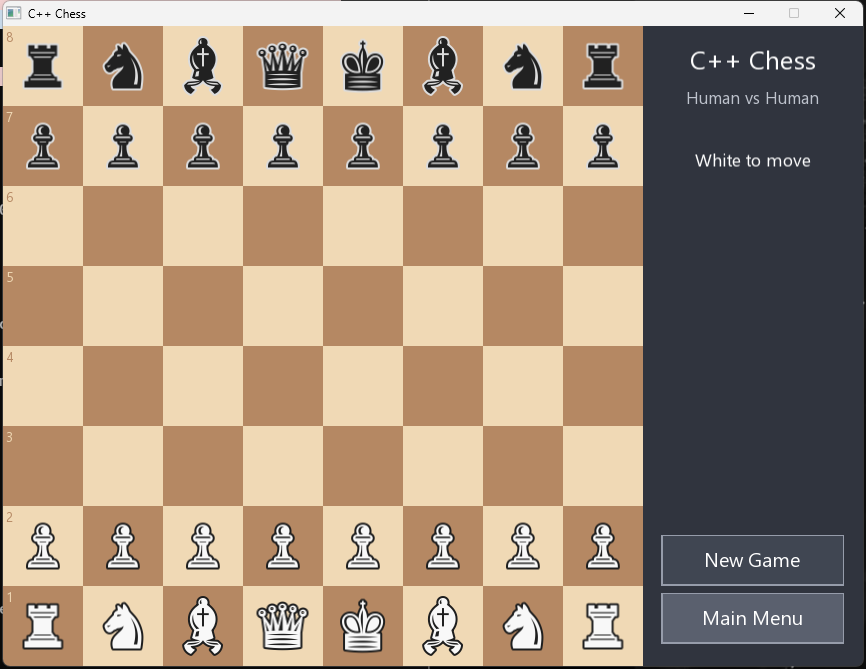
The shape of the program
The whole game is about nine hundred lines of C++20 in two
files, plus two test programs. Everything that knows the rules
of chess lives in a single header, chess.hpp: the
board, move generation, the draw rules, the evaluation, and the
search. It has no idea a window exists. The SFML front end in
main.cpp handles rendering, the menu, mouse input,
and the promotion picker, and talks to the engine only through
its public functions. That separation is what makes the engine
testable: perft.cpp and ai_test.cpp
drive it headlessly, with no graphics involved.
Step 1: the rules, all of them
Most hobby chess programs implement the moves everyone knows and quietly skip the edge cases. The edge cases are most of the work. Castling is the move where the king and a rook swap to safer squares in one turn, and it is legal only if neither piece has moved, no square the king crosses is attacked, and the king is not currently in check. En passant is the rule that lets a pawn capture an enemy pawn that just advanced two squares past it, but only on the very next move. Promotion turns a pawn reaching the last rank into a piece of the player's choice, which means the interface needs a picker, not an automatic queen.
The game also has to know when it is over, and not just by checkmate. The engine tracks the fifty-move rule (a draw when fifty moves pass with no capture or pawn move), threefold repetition (a draw when the same position occurs three times), and insufficient material (a draw when neither side has enough pieces left to ever deliver mate, such as king against king and bishop). Each of these interacts with the others, and a mistake in any of them produces games that end wrongly or never end at all.
Step 2: proving the move generator with perft
Perft, short for performance test, is the standard way to verify a chess move generator: count every legal move sequence from a position to a fixed depth and compare the total against published reference values. The numbers grow fast enough to catch almost anything. From the starting position there are exactly 20 legal first moves (each of the eight pawns can advance one or two squares, which is 16, and each knight has two destinations, which is 4 more). Black has the same 20 replies to each, so depth 2 is exactly 400. By depth 3 the symmetry is broken and the count is 8,902, and at depth 5 it is 4,865,609. One missed en passant capture or one illegal castle anywhere in that tree and the total comes out wrong.
The test suite runs five standard positions, including Kiwipete, a position designed by the chess programming community to be a torture test because castling rights, en passant, promotions, pins, and checks are all live at once. Every count matches the published values, more than ten million positions in total.
| Position | Deepest level checked | Positions at that depth |
|---|---|---|
| Starting position | depth 5 | 4,865,609 |
| Kiwipete | depth 4 | 4,085,603 |
| Position 3 (rook endgame) | depth 5 | 674,624 |
| Position 4 (promotions) | depth 4 | 422,333 |
| Position 5 (middlegame) | depth 3 | 62,379 |
Each position is also checked at every shallower depth, and all counts match the published references exactly.
Step 3: an evaluation the search can act on
To choose moves, the engine needs a number that says how good a position is. Chess engines measure this in centipawns, hundredths of a pawn's value, so the classic material scale becomes pawn 100, knight 320, bishop 330, rook 500, queen 900. Material alone plays terribly, though, because it has no opinion about where the pieces stand, so each piece type also gets a piece-square table: a grid of 64 bonuses and penalties, one per square. A knight in the corner carries a 50-centipawn penalty while a knight on a central square earns a 20-point bonus, so the same knight is worth 270 in the corner and 340 in the center, which is enough to make the engine develop its pieces toward useful squares without any explicit rule telling it to. Black uses the same tables with the rows mirrored, which in the 0-to-63 square indexing is a single XOR with 56.
Step 4: search, as negamax with alpha-beta
The search asks the only question that matters: if both sides play the best moves I can see, where does this position end up? That is minimax, evaluating the tree of possible continuations under best play by both sides. Negamax is the standard simplification: instead of separate maximizing and minimizing code, score every position from the perspective of the side to move and negate the score each time the search hands the move to the opponent. One function, half the code, same answer.
Searched naively the tree explodes, which is where alpha-beta pruning comes in. The idea fits in a sentence: once one reply refutes a move, stop looking at the other replies, because the opponent only needs one. If I am considering a move and the first response I examine already wins a rook for my opponent, no further responses can make that move look better for me, and the whole branch is abandoned. Pruning works best when the refutation is examined first, so moves are ordered before searching: captures ahead of quiet moves, biggest victims first, so taking a queen is tried before taking a pawn. With decent ordering, alpha-beta searches roughly the square root of the positions plain minimax would visit, which is the difference between depth 4 being instant and being unplayable.
Step 5: the horizon problem and quiescence
A fixed-depth search has a blind spot called the horizon effect. Suppose the search ends exactly one move after the engine plays queen takes pawn. The evaluation sees an extra pawn and reports the engine is winning, but the very next move, just past the horizon, the queen is recaptured and the engine is down a queen for a pawn. The standard fix is quiescence search: when the main search runs out of depth, do not evaluate immediately. Keep searching, but only through captures, until the position goes quiet, and only then trust the evaluation. This engine extends up to four plies of captures, which is enough to stop it walking into simple recapture traps while keeping the search fast.
Step 6: difficulty without scripted blunders
The three difficulty levels do not inject fake mistakes. Easy, Medium, and Hard search to depths 2, 3, and 4, and the lower levels also pick randomly among any root moves scoring within a margin of the best (70 centipawns on Easy, 30 on Medium, 0 on Hard). A weaker level still plays reasonable chess; it just sees less far ahead and is less predictable, which feels much more like a human club player than an engine that occasionally hangs its queen on purpose.
The random pick forced one design choice worth explaining. Deep in the tree, alpha-beta is free to prune, but at the root every move is searched with a full window:
// Search each root move with a full window so every move gets its true
// score. (A shared narrowing window would make pruned moves report the
// alpha bound instead of their real value, corrupting the pick below.)
// Deeper plies still prune with alpha-beta, which is where the savings are.
for (const Move& m : moves) {
    GameState n = makeMove(s, m);
    int val = -negamax(n, depth - 1, -INF, INF, 1);
    scored.push_back({val, m});
}
With a shared narrowing window, a root move that gets pruned reports a bound rather than its real score, and a bound is useless for deciding whether the move falls inside the 70-centipawn pool. Searching the root with full windows costs a little speed and buys true scores for every candidate, and the deeper plies still prune normally, which is where nearly all of the savings live anyway.
Step 7: keeping the window responsive
A depth-4 search can take a moment, and a UI that freezes while
the computer thinks feels broken even when nothing is wrong.
The front end therefore hands the search a copy of the game
state and runs it on a background thread through
std::async, polling for the result each frame
while the window keeps rendering, animating the pulse on the
thinking indicator, and responding to the mouse. Because the
engine works on a value snapshot rather than shared state,
there is nothing to lock and no way for a click during the
search to corrupt the position.
The interface
The front end is SFML 3. Pieces move by drag-and-drop, legal destinations appear as dots the moment a piece is picked up, the last move and any check stay highlighted, and the board flips when you play Black so your pieces always start at the bottom. Promotion pops up a picker over the board. One design decision I enjoyed: the pieces are Unicode chess glyphs drawn from fonts that ship with Windows, so the game needs no image assets at all, and the window, menu, and side panel are laid out from the same small set of spacing constants so the whole thing reads as one coherent surface.
Testing the search, and what is missing
Perft proves the move generator, but the search needs its own checks. A second test program verifies behavior a correct search cannot fail: given a mate-in-one position it finds the mate, given a hanging queen it takes the queen, and a full self-play game terminates in a legal game-over state rather than looping forever, which exercises the draw rules under real conditions.
The engine is deliberately simple, and the gaps point at what each classic technique is actually for. There is no transposition table, the cache that recognizes positions reachable by different move orders, so the search re-derives work it has already done. There is no iterative deepening, so the engine cannot use a shallow search to order moves for a deeper one. The evaluation knows nothing about king safety or pawn structure beyond what the square tables imply, and there is no opening book, so the first moves come from the same search as everything else. Each of those is a well-understood upgrade with a measurable payoff, which makes this less a finished engine than a clean baseline that plays a fair game of chess and can prove the part of itself that has a proof.
Part two: an AI that teaches itself
Everything above plays exactly as well as the knowledge I gave it. The material values and the square tables are my opinions about chess written down as integers, and the search applies them faster than I could, but it will never know anything I did not tell it. In 2017 DeepMind's AlphaZero demonstrated the opposite approach: give the program nothing except the rules, and let it discover material, development, and everything else from games against itself. The second half of the repository implements that recipe at the scale of hardware on my desk, a single consumer GPU, to measure what self-play learning looks like on an ordinary compute budget.
One network, two questions
The learner is a policy-value network, a single convolutional network that reads a position and answers two questions at once: which moves deserve attention (the policy, a probability distribution over moves) and who is winning (the value, a number between -1 for losing and +1 for winning). The board goes in as 19 stacked 8x8 feature planes, one per piece type per side plus castling rights, en passant, and the move clocks, always oriented so the network sees itself as the player pushing up the board. Moves come out of a fixed action space borrowed from AlphaZero, where every move is named by its from-square and its type: 56 queen-style moves (8 directions, up to 7 squares each), 8 knight jumps, and 9 underpromotions, making 64 x 73 = 4,672 possible actions. The move e2e4, for example, is the action "from e2, two steps forward". At 128 channels and 6 residual blocks the network has about 1.9 million parameters, kept deliberately small so self-play games come fast.
Search that learns its own guidance
On top of the network sits Monte Carlo tree search. Where alpha-beta explores every line its pruning cannot rule out, this search grows a tree one position at a time. Each simulation walks down the tree choosing the child that best balances three pulls: a high network prior (the policy thinks this move looks natural), a good running result (earlier simulations through this move went well), and a low visit count (this move has not been examined much). That balance is the PUCT selection rule from AlphaGo Zero. When the walk reaches a position the tree has never seen, the network scores it, the score propagates back up the path, and the next simulation starts again at the root. Nothing is ever played out to the end: the value head replaces rollouts entirely, which is the central trick of the method. After a hundred or so simulations the visit counts at the root are the move choice, and normalized, they are also the training target.
The data factory
Training data comes from nowhere but the network playing itself. Every position of every game becomes one sample: the encoded board, the search's visit distribution as the policy target, and the final game result, seen from that position's side to move, as the value target. Two sources of randomness keep the games from collapsing into repetition. Dirichlet noise mixes a small random tilt into the move priors at the root, forcing occasional looks at unfashionable moves, and for the first thirty plies moves are sampled in proportion to their visit counts rather than taken greedily. A freshly trained network also does not get to generate data just because it is newer: it first has to score at least 55% in a gating match against the current best network, AlphaGo Zero's rule for keeping one rough training step from poisoning the supply of games. To keep a GPU busy from Python, 32 games per worker process run their searches in lockstep, so every simulation step evaluates all of their leaves in one batch, and six workers feed the same card.
Measuring part two against part one
The two halves of the project meet in the evaluation. The learning side first checks its rules library against the same five published perft counts the C++ engine is verified with, so both halves agree on what chess is before they disagree about how to play it. Then, every couple of iterations, the best network so far plays a fixed ladder of opponents: a player that moves uniformly at random, a one-ply greedy player that grabs the largest capture it can see, and the alpha-beta engine from part one at increasing depths, reached through a fifty-line command-line bridge that reads a position and answers with the engine's chosen move. The ladder never changes, so the win rates trace a learning curve against unmoving yardsticks, and the tests pin the search itself down before any learning happens: with a completely untrained network, the tree search must still find a mate in one, which separates the correctness of the search from the strength of the model.
The scale deserves stating plainly. AlphaZero trained on thousands of TPUs and reached superhuman chess within hours; this is one RTX 4090, several orders of magnitude less compute, so superhuman play is not the goal and would not be a credible claim. What the setup measures is the shape of learning at desktop scale. At iteration zero the untrained network scored 0.29 against even the random player, which is worth pausing on: an untrained network is worse than chance, because its confidently wrong evaluations steer the search into consistent mistakes where uniform randomness would at least be unbiased.
The first thing the running system produced was not a learning curve but a lesson about the loop itself. Two weak networks draw nearly all of their gating games, so for seven straight iterations no candidate could clear the 55% promotion bar, and in my first version of the loop a rejected candidate was rebuilt from the unchanged best network each iteration, which meant training never compounded: the evaluation numbers wobbled with match noise while nothing actually learned. The fix follows what the AlphaZero paper itself did when it dropped gating entirely: train one network continuously and unconditionally, and let the gate decide only which snapshot is trusted to generate data. With that change the training loss compounds from iteration to iteration and the first promotion came within minutes. The run is in flight as I write this, and the evaluation log in the repository is the living record of how far self-play gets on a desk.